
Themeflow Momentum
A Quantitative Approach to Sector and Theme Rotation

Financial markets tend to move through recurring cycles of expansion and contraction, but these cycles rarely affect every part of the market equally. Different areas respond differently to changes in the economic environment, with some proving far more sensitive than others. Industries driven by rapid technological innovation, shifts in consumer demand, government regulation, monetary policy, or fluctuations in commodity prices often experience more pronounced swings in performance than the broader market. This will attract significant investor interest and capital.
These highly responsive areas can deliver exceptional returns during periods of favorable conditions. However, the same forces that drive rapid growth can also lead to sharp and sustained declines when conditions change.
For investors, this creates both opportunities and risks. Successfully investing in hyped fast-moving segments of the market requires more than identifying popular or fast-growing themes. It requires a framework.
Testing the Theory
To evaluate whether a systematic approach can successfully capture trends in highly cyclical sectors, I will apply the same dual momentum strategy introduced earlier (see below).
Golden Dual-Momentum Rotation

Gold has been humanity’s go-to store of value for thousands of years. Bitcoin, with its built-in scarcity and fixed supply schedule, has been dubbed “digital gold” by its proponents. But should you own one, the other or both and in what proportion?
The test portfolio consists of a collection of thematic ETFs that have each experienced periods of explosive outperformance, typically accompanied by compelling narratives that captured investors’ attention. These narratives—summarized below with “meme-grade” bull cases which reflect the stories that often dominate market sentiment during strong uptrends:
XLE – “Peak Oil, baby.”
SOXX – “This time tech isn’t a bubble.”
IGV – “Software eats the world.”
IBB – “One FDA approval away from a face-ripping rally.”
TAN – “Solar died enough times that everyone forgot it can double.”
GDX – “Money printer goes brrrr.”
SIL – “Poor man’s gold.”
REMX – “Geopolitical FOMO.”
Although these descriptions are intentionally humorous, they represent the types of narratives that frequently accompany major thematic booms. The objective of this analysis is not to determine whether these stories are fundamentally correct, but rather to examine whether a disciplined dual momentum strategy can systematically identify when these themes are gaining strength, while also providing an objective signal for exiting when market leadership begins to fade.
To limit concentration risk the maximum allocation per ETF is 33.33%, if it’s the only active one. The portfolio is recalculated once every month.
The Results
The sample period is from 2011 to 2025. The following chart presents the annual returns of the strategy.
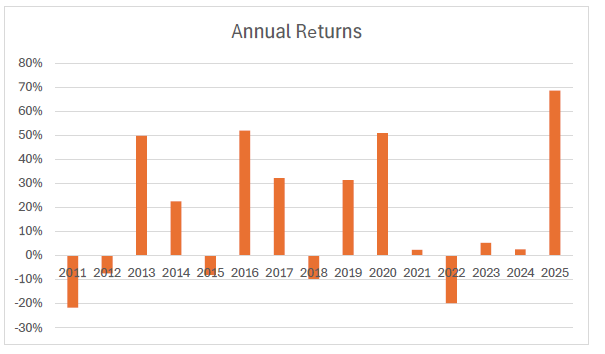
The annual returns demonstrate the defining characteristics of a momentum-based strategy applied to highly cyclical sectors: periods of substantial outperformance interspersed with drawdowns. Rather than delivering steady year-to-year returns, the strategy experiences considerable performance dispersion.
This chart shows the asymmetric nature of momentum investing: while losses during unfavorable periods are meaningful, they are often offset by occasional years of exceptionally strong performance when major trends develop.
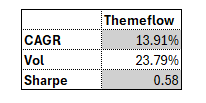
The summary performance statistics indicate that the strategy delivered strong long-term returns, albeit with substantial volatility. A compound annual growth rate (CAGR) of 13.91% compares favorably with the historical returns of broad equity markets, suggesting that the dual momentum approach was successful in capturing prolonged advances in cyclical sectors over the sample period.
This higher return, however, came at the cost of elevated risk. The portfolio exhibited an annualized volatility of 23.79%, which is higher than that of a typical diversified equity index. Such volatility is expected given the strategy’s concentrated allocation (max 4 positions – 25% allocation each).
When both return and risk are considered together, the strategy achieved a Sharpe ratio of 0.58. While this is not exceptionally high, it represents a respectable level of risk-adjusted performance for a portfolio intentionally focused on volatile, high-beta market segments. The Sharpe ratio suggests that the strategy was compensated for the additional risk it assumed. Investors were required to tolerate significant fluctuations in portfolio value along the way.
Taken together, these metrics illustrate the fundamental trade-off embedded in momentum investing within cyclical sectors. The strategy was capable of producing attractive long-term capital growth, but investors needed to accept above-average volatility and periodic drawdowns to achieve those returns. Rather than delivering smooth performance, the strategy relied on capturing relatively infrequent but powerful market trends that more than compensated for weaker periods.
Further Work
One limitation of the strategy is its relatively small investment universe, consisting of only eight sector ETFs. While these assets were intentionally selected to represent highly cyclical areas of the market, such a limited opportunity set may restrict the effectiveness of the momentum model. Having a larger and more diverse universe of assets increases the probability of identifying strong trends while reducing the likelihood of being forced into relatively weak investment opportunities.
Expanding the asset should improve diversification. A broader selection allows the strategy to rotate among a wider range of market leaders, potentially enhancing returns while reducing concentration risk. It may also improve performance during periods when the original set of assets experiences weak returns.
Another potential enhancement is the incorporation of a volatility cap. Rather than allocating capital solely based on momentum rankings, the strategy could impose a volatility cap to limit exposure to exceptionally volatile assets. This could increase risk-adjusted performance.
Key Takeaways
No Smooth Return Distribution: Rather than delivering smooth annual gains, the momentum strategy relies on capturing infrequent, highly powerful trend cycles that offset periods of drawdowns and performance dispersion.
Volatility cuts both ways: The same forces that create explosive rallies in thematic sectors can also cause sharp, sustained downturns.
A systematic framework beats narrative-chasing: Successfully investing in hyped themes requires more than following popular stories; it demands a disciplined, rules-based approach like dual momentum.
Conclusion
The results of this analysis suggest that a disciplined, rules-based approach can meaningfully improve the odds of successfully navigating highly cyclical, narrative-driven sectors of the market. Rather than relying on gut instinct or chasing headlines, the dual momentum strategy provided an objective mechanism for identifying when thematic trends were gaining strength and, just as importantly, for stepping aside when that leadership began to fade.
The strategy’s performance demonstrates that momentum can be a powerful tool for capturing the outsized gains these sectors are capable of producing. But this performance did not come for free. With annualized volatility approaching 24% and a Sharpe ratio of 0.58, the strategy is a reminder that there is no free lunch in cyclical, high-beta investing. Investors pursuing this kind of approach must be prepared to endure meaningful drawdowns in exchange for the possibility of outsized gains during the market’s most explosive uptrends.
This analysis represents a starting point rather than a finished product. Expanding the investment universe beyond eight ETFs and introducing risk-management tools like a volatility cap are natural next steps that could further improve the strategy’s risk-adjusted returns.
Disclaimer
The above article constitutes my or the authors’ personal views and is for entertainment purposes only. It is not to be construed as financial advice in any shape or form. Please do your own research and seek your own advice from a qualified financial advisor. I / The authors may from time to time hold positions in the aforementioned securities consistent with the views and opinions expressed in this article. The information provided in this article is not making promises, or guarantees regarding the accuracy of information supplied, nor that you guarantee for the completeness of the information here. The information in this article is opinion-based and that these opinions do not reflect the ideas, ideologies, or points of view of any organization the authors may be potentially affiliated with. The authors reserve the right to change the content of this blog or the above article. The performance represented is historical and that past performance is not a reliable indicator of future results and investors may not recover the full amount invested.